
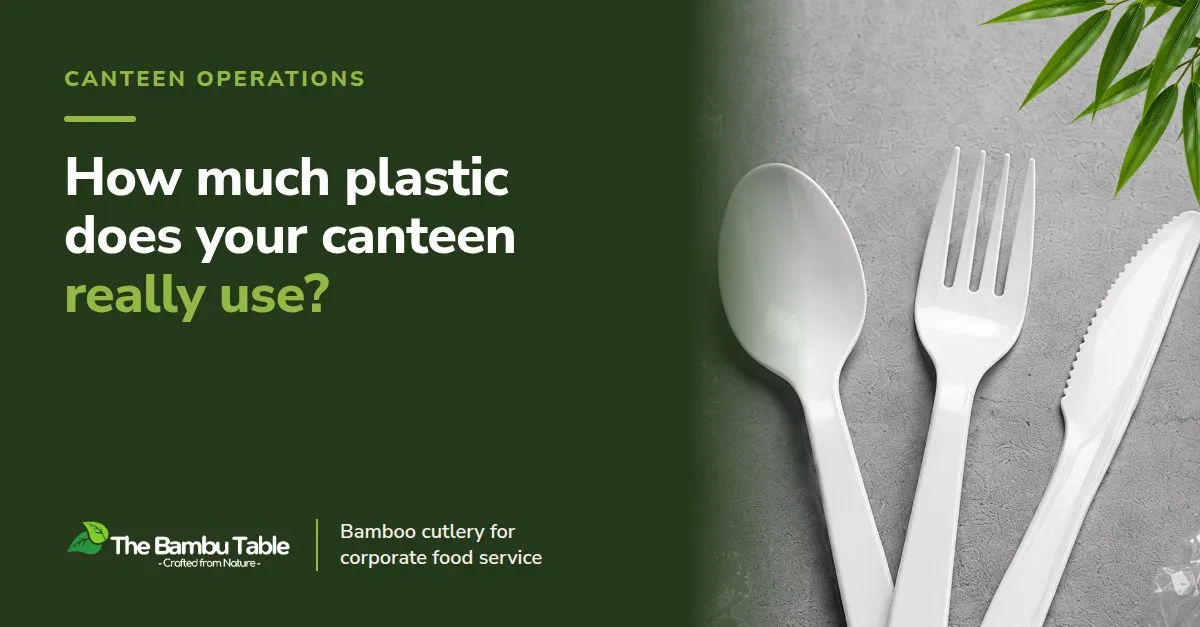
Ask a facilities or catering manager how much plastic cutlery their canteen uses and the honest answer is usually “a lot”. Very few organisations have put a number on it. Cutlery is a low-cost consumable that arrives in cartons, is used for a few minutes and is thrown away. It rarely features in sustainability reporting.
Yet it is one of the most visible forms of single-use plastic in the workplace. Every employee handles it every day. Putting a number on it is the first step to doing something about it, and it is simpler than most people expect.
The worked example: a 1,000-meal canteen
Take a staff canteen serving 1,000 meals a day. Assume it operates on working days only, which is about 260 days a year (five days a week for 52 weeks). And assume each meal comes with a fork, a knife and a spoon.
| Utensil | Per day | Per year (260 days) |
|---|---|---|
| Forks | 1,000 | 260,000 |
| Knives | 1,000 | 260,000 |
| Spoons | 1,000 | 260,000 |
| Total utensils | 3,000 | 780,000 |
That is 780,000 single-use plastic utensils a year, from a single canteen of a size that is common at corporate head offices, factories, mines, hospitals and universities. A contract caterer running twenty such sites would be handing out more than 15 million.
From items to kilograms
Weight is often the more useful figure for sustainability reporting. Disposable plastic cutlery varies in weight by type, size and material, but for estimation we assume an average of 4 grams per utensil.
780,000 utensils × 4 g = 3,120,000 g, or about 3.1 tonnes of plastic a year.
And carbon
Plastic has a carbon footprint from production through to disposal. Using an indicative emission factor of 3 kg CO2e per kg of plastic, 3,120 kg of plastic corresponds to roughly 9.4 tonnes of CO2e a year. Treat this as an estimate: emission factors vary by polymer, source and system boundary, and a full comparison would also account for the footprint of whatever replaces the plastic.
Why cutlery is a problem plastic
Plastic cutlery is typically made from polystyrene or polypropylene. In principle, both can be recycled. In practice, small items such as forks and spoons are difficult to capture in sorting systems, and cutlery from a canteen is almost always contaminated with food. It is reasonable to assume that most used plastic cutlery is not recycled.
That is why many organisations treat cutlery as a priority for substitution rather than recycling. Replacing it is simple, visible to employees and relatively low cost compared with other plastic reduction measures.
Estimate your own canteen
Every canteen is different. Some serve far more than 1,000 meals; some operate seven days a week; many do not hand out all three utensils with every meal. The calculator below lets you adjust for that.
Estimate your canteen's plastic use
Every year, switching to bamboo would avoid:
- Plastic utensils avoided
- 780,000
- Plastic waste avoided
- 3,120 kg
- Estimated CO2e avoided (estimate)
- 9,360 kg
- Renewable bamboo used instead
- 2,340 kg
How we calculate this
- Utensils per year = meals per day × operating days × utensils per meal.
- Plastic weight assumes 4 g per plastic utensil.
- Bamboo weight assumes 3 g per bamboo utensil, from our product specifications.
- The CO2e figure is an estimate using 3 kg CO2e per kg of plastic avoided. It does not net off the footprint of the bamboo product. Your assessment and monthly ESG reports use our documented methodology.
A few tips for a more accurate estimate:
- Use actual meal counts. Your caterer or point-of-sale system will have daily covers. An average over a month is better than a guess.
- Count operating days properly. Include weekends and shifts if your site runs 24/7. Exclude shutdown periods.
- Check what is actually handed out. Do staff take a full set every time, or only what they need? Are takeaway packs different?
- Add up all sites. For multi-site organisations and caterers, the total across sites is often the number that gets attention.
Multi-site organisations and caterers
The numbers become more striking at scale. A contract caterer, or a company with several campuses, factories or mines, should add up every site, because the portfolio total is usually what decision-makers respond to.
A practical way to do this is a simple table with one row per site: average daily meals, operating days and the utensils typically handed out. Sites that run around the clock, such as mines, hospitals and manufacturing plants, often serve meals on every day of the year and across several shifts, so their annual totals can be far higher than an office canteen of similar daily size.
It is also worth separating loose cutlery from individually packaged sets. Packaged sets add a sleeve, and sometimes a napkin, to every meal, which matters both for waste and for the alternative you choose.
Finally, note where the data came from: point-of-sale records, caterer reports or estimates. When you later report progress, being clear about the source of your baseline makes the before-and-after comparison credible.
What to do with the number
An estimate like this is useful in three ways.
It sizes the opportunity. Knowing that your canteen uses hundreds of thousands of plastic items a year turns a vague intention into a concrete target.
It supports the business case. Sustainability, procurement and finance teams can weigh the change against other initiatives using real figures rather than impressions.
It sets a baseline for reporting. If you switch, the same calculation, using actual delivery and usage data, becomes the basis for reporting progress month by month.
Switching without the guesswork
Replacing plastic cutlery with genuine bamboo is one of the most straightforward plastic reduction steps a canteen can take. It does not change how food is served, it needs no new equipment and staff notice the difference immediately.
The figures above are estimates. A free Corporate Plastic Footprint Assessment uses your own meal counts, sites and current cutlery to calculate your actual plastic consumption, identify reduction opportunities and propose a 30-day pilot, with the reporting you would receive if you switch.

Bamboo cutlery for corporate food service, manufactured in South Africa
Follow on LinkedIn