
Not legal advice. This article summarises European rules for a South African audience. It is general information only. Check the official texts and take professional advice on how they apply to your organisation.
For South African companies that are part of a European or global group, sustainability policy often arrives from head office. A new group standard is issued, regional teams are asked to align, and local sites, down to the staff canteen, find themselves applying rules that were written with another market in mind.
That is why Europe’s latest packaging legislation is worth understanding in South Africa, even though it is not South African law.
The rules in brief
Single-use plastic cutlery: already banned in the EU
Under the EU Single-Use Plastics Directive (Directive (EU) 2019/904), EU member states have prohibited the placing on the market of certain single-use plastic products, including plastic cutlery (forks, knives, spoons and chopsticks), since 3 July 2021.
In practice, that means staff canteens at European sites of multinational companies moved away from plastic cutlery several years ago.
The Packaging and Packaging Waste Regulation (PPWR)
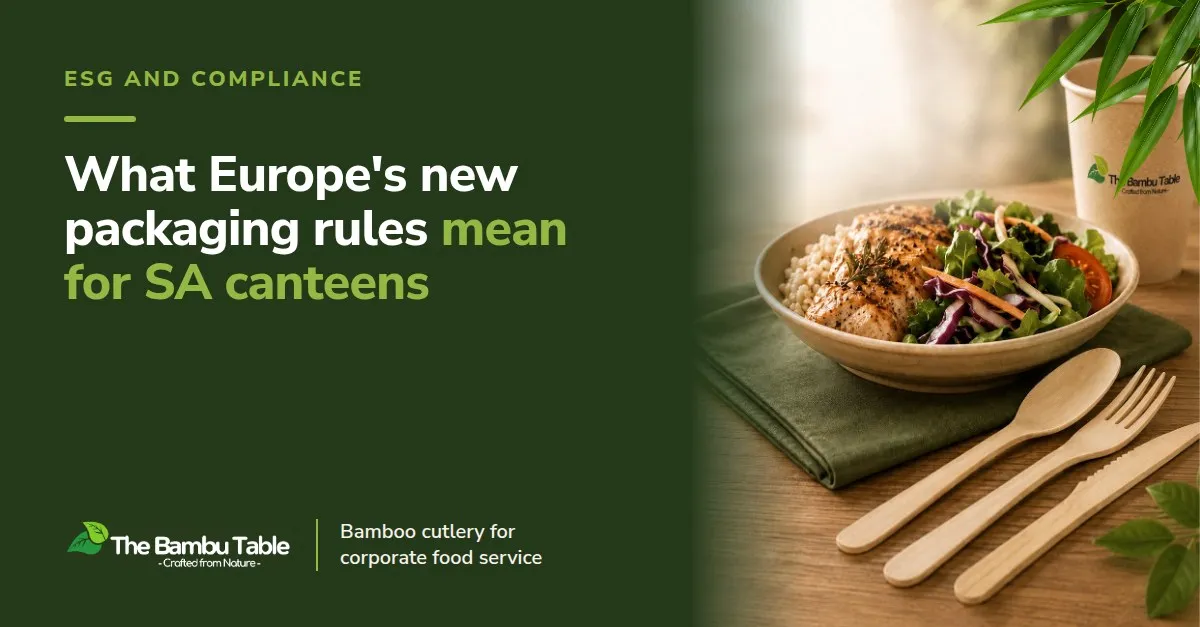
The EU adopted a new Packaging and Packaging Waste Regulation, Regulation (EU) 2025/40, which was published in January 2025 and entered into force in February 2025. Most of its provisions have applied since 12 August 2026.
As a regulation rather than a directive, it applies directly in every member state. It covers a wide range of requirements for packaging placed on the EU market, including recyclability, recycled content, minimising packaging, labelling and, over time, restrictions on certain single-use packaging formats.
PFAS in food-contact packaging
One provision has attracted particular attention in food service. From 12 August 2026, the PPWR restricts the placing on the EU market of food-contact packaging containing per- and polyfluoroalkyl substances (PFAS) above set concentration limits.
PFAS, often called “forever chemicals”, have been used to give paper and fibre-based food packaging grease and water resistance. They are highly persistent in the environment, and the restriction reflects growing concern about their effects.
Why this matters in South Africa
These rules govern products placed on the EU market. They do not apply to products used in South Africa, and South African law does not currently require the same. Nothing in this article should be read as suggesting otherwise.
They matter here for a different reason: the way multinational groups manage sustainability.
One group, one standard
Large groups increasingly set a single procurement and sustainability standard across all countries. There are good reasons for this:
- Consistency of reporting. Group sustainability reports cover all operations. Different standards in different countries complicate data collection and weaken the group’s claims.
- Reputation. A group that has removed plastic cutlery and PFAS-treated packaging from its European canteens may not want different practices elsewhere to be visible to employees, investors or the media.
- Simplicity. One specification for all sites is easier to manage than many.
- Direction of travel. Rules adopted in Europe often influence policy elsewhere, so aligning early can reduce later disruption.
The result is that a South African subsidiary may be asked, by its group, to meet European expectations voluntarily: no plastic cutlery, and packaging that avoids substances restricted in the EU.
What this means for the canteen
For a South African canteen within a multinational group, a few practical points follow.
Plastic cutlery is the obvious first change. If European sites have used alternatives since 2021, plastic cutlery at a South African site stands out.
Packaging matters as well as the cutlery. Packaged cutlery sets come in a sleeve, often paper. If group policy follows the EU approach to PFAS, the sleeve should be checked as well as the cutlery itself.
Documentation will be requested. Group procurement and sustainability teams will want evidence: material specifications, food-contact documentation and declarations on substances of concern.
Consistent reporting helps. Monthly data on plastic items replaced gives the local team something concrete to contribute to group reporting.
Questions to ask your cutlery supplier
- What is the cutlery made of? Please provide a written material specification.
- What food-contact documentation can you provide?
- Are the cutlery and its packaging free of intentionally added PFAS? Can you provide a declaration?
- Where is the product manufactured?
- What sustainability data can you provide for our reporting, and how is it calculated?
If a group standard lands on your desk
When group procurement or sustainability teams issue a new standard, local teams are often given a deadline and little detail. A few steps make the response easier.
- Clarify the requirement. Ask whether the standard covers only cutlery, or also cups, containers and packaging, and whether it applies to your caterer’s purchases as well as your own.
- Map current products. List what each site uses today, who supplies it and what documentation exists. Gaps in documentation are often the biggest task.
- Check local alternatives. Locally manufactured products can shorten lead times and simplify supply, which matters when a deadline is set by head office.
- Pilot at one site. Test the alternative with real meals and staff before rolling it out, and use the results to report progress to the group.
- Agree the reporting. Decide early what data the group needs, such as items replaced or plastic weight avoided, and make sure your supplier can provide it each month.
The bottom line
Europe’s packaging rules are not South African law, and South African canteens are not obliged to follow them. But for companies that are part of global groups, they are a strong signal of where group policy is heading. Replacing plastic cutlery with a genuine, well-documented alternative, and being able to report on it, is a straightforward way for a local site to get ahead of that conversation.

Bamboo cutlery for corporate food service, manufactured in South Africa
Follow on LinkedIn