
Walk into almost any corporate canteen that has moved away from plastic cutlery and you will find wooden-looking forks, knives and spoons in the dispensers. The packaging might say “bamboo”, “eco wooden” or simply “natural”. Procurement has ticked the box. The sustainability team has a line for the annual report.
But in South Africa, a great deal of what is sold as bamboo or eco wooden cutlery is actually birchwood. The two materials look similar at a glance, which is exactly why the difference goes unnoticed. For a canteen that has made a public commitment to plastic reduction, it is worth knowing which one you are buying.
Two very different raw materials
Bamboo is a grass. Some bamboo species grow remarkably quickly and can be harvested in roughly three to five years. Once cut, many species regrow from the existing root system without the need to replant.
Birch is a hardwood tree. Birch used for disposable cutlery is typically grown in commercial forestry and takes in the region of 15 to 25 years to mature, depending on species and conditions, before it is felled and replanted.
Both can be responsibly sourced. Both are better than single-use plastic in the sense that they come from renewable biological material rather than fossil fuels. But they are not interchangeable, and they do not support the same sustainability claims.
| Topic | Bamboo | Birchwood | Why it matters to a buyer |
|---|---|---|---|
| Growth and harvest | A rapidly renewable grass, harvestable in about 3 to 5 years; regrows from its roots | Timber from trees that take roughly 15 to 25 years to mature; felled and replanted | Bamboo is the genuinely renewable choice |
| Strength and safety | Dense fibre, strong, low splinter risk | Rigid but can splinter when it snaps | Safer, better dining experience |
| Finish and mouthfeel | Naturally smooth | Can feel dry or papery and absorb liquid | Higher staff satisfaction |
| Land impact | A grass that helps stabilise soil | Draws on commercial forestry | Stronger biodiversity story in ESG reporting |
Why canteens end up with birchwood
There is nothing sinister about most of this. Birchwood cutlery is widely produced, widely imported and inexpensive. It is often described in general terms such as “wooden”, “eco” or “natural”, and in the trade those words can blur into “bamboo”. A buyer comparing two cartons of pale disposable cutlery on price may reasonably assume they are equivalent.
The confusion is compounded by the fact that the end user, an employee eating lunch, has no reason to look closely. Unless someone in procurement asks for a written material specification, nobody checks.
If the specification sheet says birch, it is not bamboo, however it is marketed.
Why the difference matters
1. Your sustainability claim
If your sustainability report, intranet or canteen signage says you have switched to bamboo cutlery, the claim should be true. Sustainability claims are increasingly scrutinised by investors, employees and clients, and an inaccurate material claim, however innocent, undermines the credibility of the wider programme.
The renewability story is also different. “We replaced plastic with a fast-growing grass that regrows from its roots” is a stronger and more specific statement than “we replaced plastic with wood”.
2. The dining experience
Employees notice cutlery. A fork that splinters when it snaps, or a spoon that feels dry and absorbs soup, becomes a small daily irritation. Over thousands of meals, it shapes how staff feel about the switch away from plastic, and whether they see it as an improvement or a compromise.
Dense, smooth bamboo is generally more pleasant to use. The best way to judge is not to take any supplier’s word for it, including ours, but to test samples side by side with a real meal.
3. Reporting you can stand behind
Many organisations now report on single-use plastic reduction. If your cutlery supplier provides impact data, the material it is based on matters: weight per item, the renewable resource it replaces and the claims made about it should all trace back to an accurate specification.
How to tell if you are buying real bamboo
You do not need a laboratory. A short checklist covers most of it.
- Ask for the material specification in writing. It should name bamboo explicitly as the material, ideally on the product specification sheet and the invoice. “Wooden”, “eco” or “natural” on their own are not specifications.
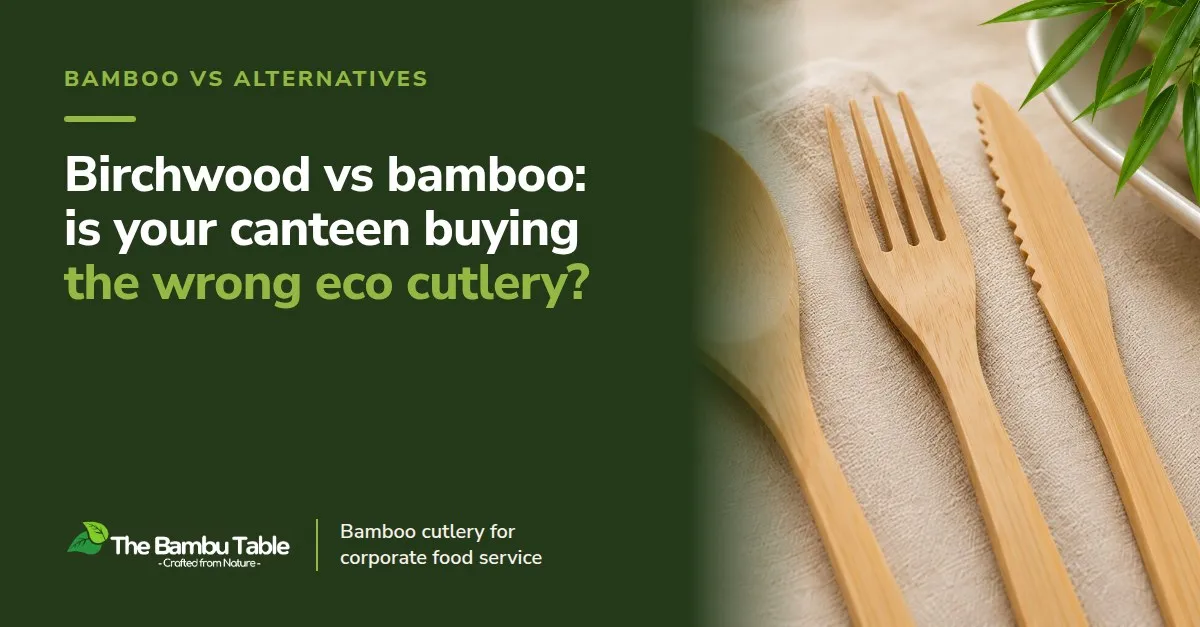
- Check the colour and grain. Bamboo typically has a warm, golden tone and fine, parallel fibres running along its length. Birch is usually paler, with a more uniform wood grain.
- Do a simple snap test. Break a sample fork. Look at how it breaks and whether it leaves sharp splinters.
- Try it with a real meal. Use a sample with a hot, saucy dish and see how it feels in the mouth and whether it softens or absorbs liquid.
- Ask where and by whom it is made. A supplier should be able to tell you the manufacturer and the country of manufacture, and ideally show you the production process.
Writing it into your catering contract
If your canteen is run by a contract caterer, you may not buy the cutlery yourself. That does not mean you cannot specify it. Many organisations include sustainability requirements in their catering contracts, and cutlery is one of the simplest to define: the material (genuine bamboo), any required documentation (material specification and food-contact documentation) and the reporting you expect (for example, monthly figures on plastic items replaced).
Specifying the material, rather than just “eco cutlery”, removes ambiguity for everyone, including your caterer.
Where we stand
We manufacture disposable bamboo cutlery in South Africa, and we think buyers should know exactly what they are getting. That means a clear material specification for every product and the freedom to test before committing.
The simplest next step is to put the two materials side by side in your own canteen and decide for yourself.

Bamboo cutlery for corporate food service, manufactured in South Africa
Follow on LinkedIn